Ladakh, India
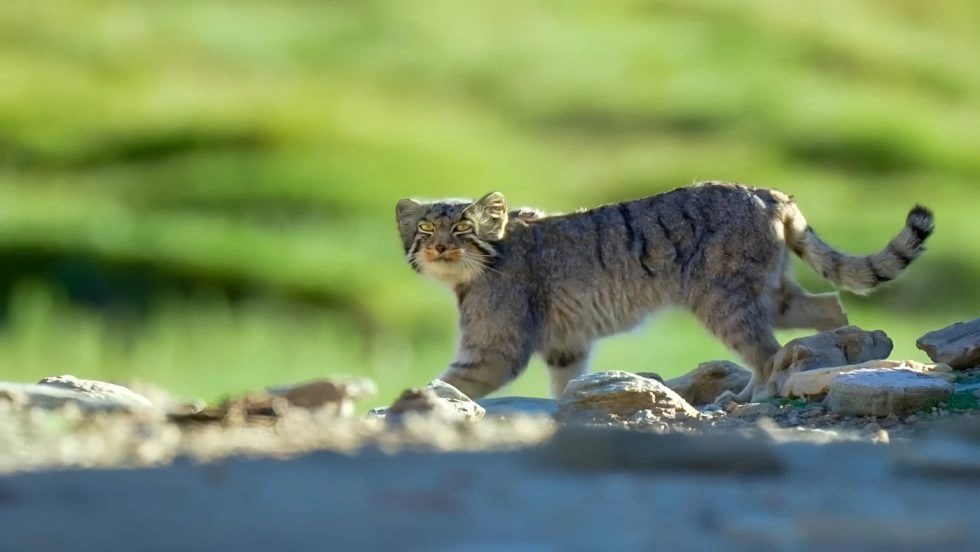
Pallas Cat is a high altitude wild cat species residing in the Trans Himalayan belt of the Himalayan range, from the Union Territory of Ladakh in the north of India. It is often referred to as the grumpiest cat in the world in much of the wildlife literature.
Speaking about its physical features, unlike other cats, it has small square ears with a squarish flat head when seen in profile. It also sheds its winter coat in summer, like its peer species of the cold arid regions of the Himalayas. Its colours are perfect camouflage grey scales with a light rufous tinge.
The habitat of the Pallas Cat is typically a rock amalgamation, or clusters of rocks in the midst of meadowlands. It also uses rocky boulders and stones to raise its young ones. It is also known to use isolated grassland parts of meadowlands, particularly when it leaves its young ones in its old habitat to fend for themselves after they have grown up.
It has also been observed using abandoned human structures like old houses on a few occasions. In winters, the Pallas Cat is known to use its furry body as perfect camouflage as part of rock clusters, thus evading aerial predators like the Golden Eagle. It stays static for hours in sunlight, appearing like a rock when seen from an aerial perspective.
The Pallas Cat remains in breeding duty and looks after its young ones for almost 100 to 110 days after birth, before finally leaving the existing territory for the young ones to thrive.
Some observations have shown that they migrate about 20 kms to start a new family. This time, it may choose a completely new habitat of meadows with short stunted grass, where there are no rocks or boulders. The habitat range of the Pallas Cat is roughly about 100 square miles, so it is always a challenge to find this species outside its breeding periods.
Its food mainly consists of rodents, voles, and marmots, and it has a typical behaviour of using a wiggle of the tail to divert the attention of its prey. It is a stealthy hunter, using a technique of body rotation at vole hiding spots.
Wiggling of the black tip on the tail often has a hypnotic effect on its prey. In our observations, Golden Eagles and Steppe Eagles are its only natural dangers.
At Oriental Odysseys, we keep regular monitoring of this elusive species in tandem with the local youth of this remote Himalayan landscape. This also provides an extended hand in the conservation of this magnificent species.
Observation Period:
The above behaviour has been observed during the months of July and August in 2016, 2017, and 2018.
Pallas Cat
Article